
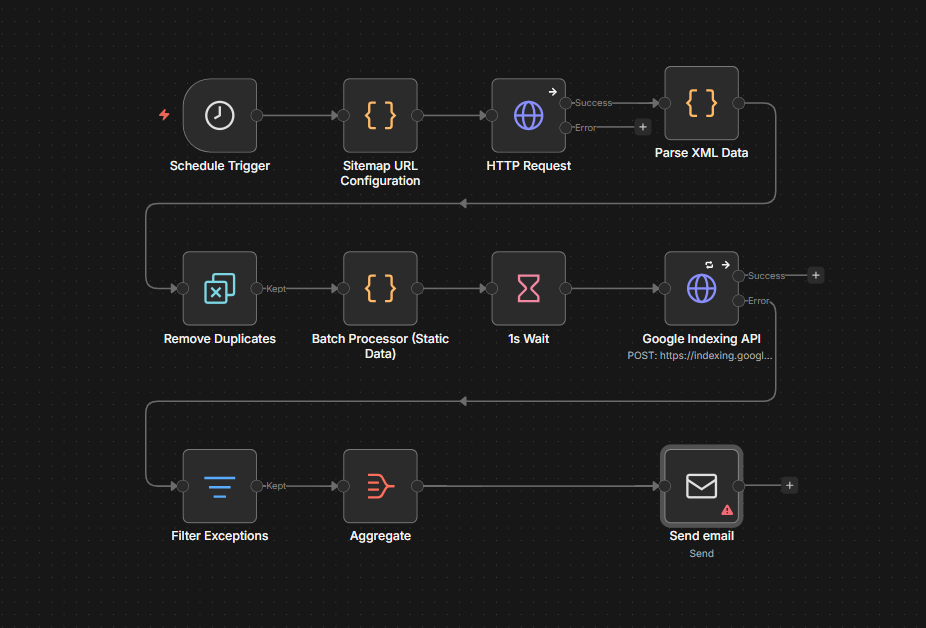
Woocommerce Store to Automated Google API Product Feed (n8n Workflow)
$4.99
Title: Woocommerce Store to Automated Google API Product Feed
Stop waiting for Google to crawl your store. Built by a developer with years of experience managing 2,000 to 9,000 product WooCommerce catalogs, this Intellanodes blueprint automates the indexing of your entire inventory. It intelligently handles the 200 products per day API limit, features a built-in deduplication engine to protect your quota, and utilizes secure OAuth2 credentials for maximum reliability. Perfect for large stores that need instant search visibility for new parts and catalog updates.
Description
Woocommerce Store to Automated Google API Product Feed
Manage your store visibility without the manual grind of Google Search Console. This blueprint was built by a developer with years of experience managing high-traffic WooCommerce sites containing between 2,000 and 9,000 products. We understand the massive amount of labor required to keep large catalogs indexed and up to date, so we built a system to do it for you.
This automation acts as your digital assistant by scanning your sitemaps and communicating directly with the Google Indexing API. It is specifically designed for stores that need their product pages updated or added to search results immediately rather than waiting weeks for a standard crawl.
Key Sales Features:
- Direct Google API Integration: Tells Google exactly which pages to look at right now.
- Smart Batch Processing: Automatically stays within the Google Indexing API limit of 200 products per day.
- Deduplication Engine: Ensures you never waste your daily API quota on the same link twice.
- Support Policy:
-
Zero-Support Asset.
-
These workflows assume you have knowledge of the n8n workflows and how to set them up.
-
Also, that you can setup a server to locally host n8n (Docker or VPS). Most of these workflows require SSL or https to work.
-
And that you are familiar with API’s, Oauth, Oauth2, setting up and getting the access keys.
-
Blueprint is provided “as-is” in
.jsonformat for direct import. -
Users are responsible for mapping input variables to their specific data source.
-
Related products
-
Comprehensive Weather & Space Weather Alerter V5.0 – n8n Workflow
$4.99 Add to cart -
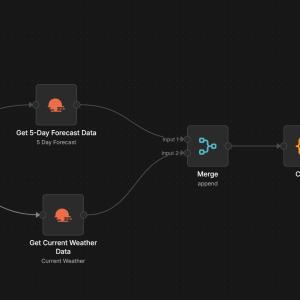
Basic Weather Email Daily Forecast – n8n Workflow
$4.99 Add to cart -
Industrial Data Transformer – Woocommerce Product Field Transformer/Cleaner (n8n Node)
$4.99 Add to cart -
Amazon DD+7 Payout Tracker (n8n Automation) – Never Miss a Release Again
$4.99 Add to cart